Monday, September 9, 2013

Typewriter Spotting

As my wife and I work our way through our addiction to Mad Men I'm wondering if others in the typosphere have recognized what a fine venue the series, set in the 1960's, is for typewriter spotting. A description I've heard of the series as "relentlessly nostalgic" is right on. The office of the 1960's Madison Avenue advertising agency is of course filled with IBM Selectric I's, the "golf ball" typewriter. Quick shadowy glimpses of other machines create an identification challenge. But Don Draper's personal typewriter, identical to my beloved high school machine, was easy.

Poor Don Draper. Occasionally deeply empathetic in his relationships with women, he can also be crudely clueless. Here he is trying to compose a note of apology to his secretary, whom he has managed to cause to leave the office in tears.
The solid and smoothly functioning late 1950's Olympia SM3 is no help. His secretary has developed an adoration for him;
they both realize it is best she seek another position. But when she asks him to write her a letter of recommendation,
hoping he might cast a few crumbs of recognition and appreciation her way, he tells her to write one up herself, saying
whatever she likes and he'll sign it. He has no idea why she responds by hurling a desk ornament at him.
He's barely begun the second sentence of his letter of apology, and already he's talking about himself. He's clueless,
but the SM3 is a great typewriter.

Sunday, September 8, 2013

On the Pleasure of the Flow of an Afternoon in Good Company


Art on the Divide Gallery, Georgetown, California
Our Sunday morning didn't start out that way. With a pleasurable flow, that is. Although Hilda and I had both been absorbed for the last week and more in preparing for the opening party for my little art show, we were reluctant to begin the day. Hilda had been planning and preparing hors d'oeuvres, and I'd kept on adding to and embellishing the presentation up to the last minute. We were pooped. So instead of leaping out of bed on D day, we both slept in. Not with that pleasurable lassitude deriving from the prospect of a lazy Sunday, but out of reluctance to initiate a day that would take more energy than we felt we had to get it rolling.

But rolling was eventually accomplished, in that gradual but noisy fashion of a steam engine pulling out from a station, with the sound and fury of billows of steam, loud exhortations of puffing and chuffing, and eventually rolling merrily along fueled by its own momentum.

Hilda puts final touches on her creations while a
soft summer breeze wafts through the old building ...
A momentum aided mightily, once we finally managed to present ourselves at the gallery, by the other coop members. They pitched in by helping to carry and set up and fill in gaps. There appeared a bouquet cut from the gallery's own historic rose garden, the corkscrew we forgot, music, balloons, wine from home-grown grapes, and more snacks. And soon the day that we had been so reluctant to begin was merrily rolling along, impelled by the pleasure of good conversation in the company of friends, conversation the flowed the afternoon too quickly away.

... and the guests begin to blow in.

Saturday, September 7, 2013

Smith Corona Silent-Super

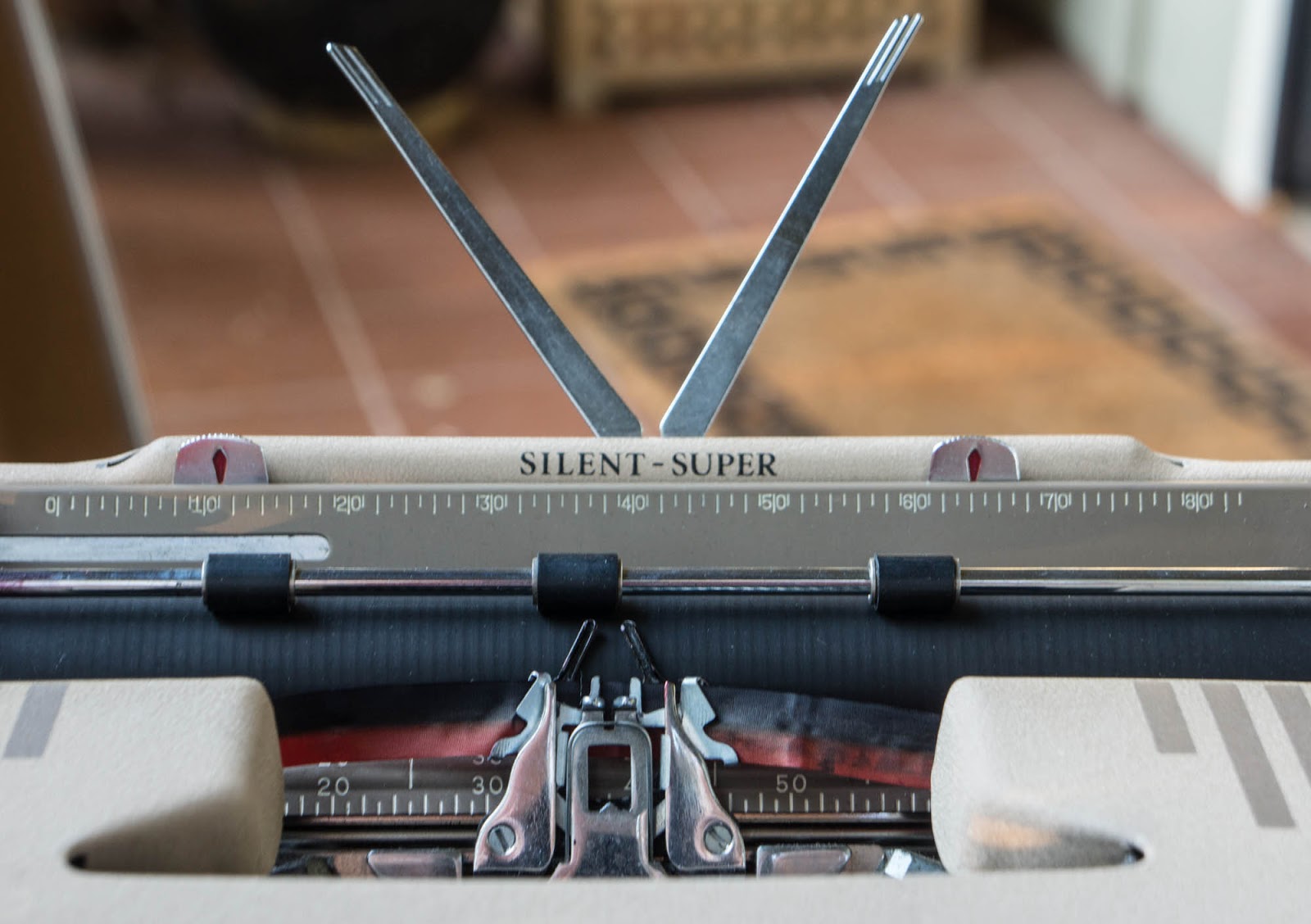
Super, indeed. Found this week at the local Salvation Army Thrift Shop, this typer is among the smoothest-functioning and quirk-free machines in my growing collection, and all I've done is replace the ribbon.
Smith Corona Silent-Super, circa 1958-59
The color is attractive, as is the fine sandy texture. And it retains the vestigial art deco Smith Corona stripes.


It has a nifty system to anchor it within the case:

The lever on the left withdraws a tab from the front of the typewriter, which can then be removed from the case.


Set the typewriter back in the case and it snaps into place.

This model was re-branded and sold by Sears as the Tower Quiet Tabulator:

The Tower Quiet Tabulator as shown on Richard P's "Writing Ball" blog 
Alan Seaver's blog, Machines of Loving Grace, includes an interesting article on catalog store re-brand of typewriters 

Wednesday, September 4, 2013

Exa Excitement

Some time ago I posted about the excitement of receiving my first "real" camera, an Exakta VXIIa, that came all the way from Switzerland. That was back in 1958 when I was a high school senior. That wasn't quite so long ago as when imaging was the province of shamans with ground pigments in the secret recesses of caves, but it might as well be, given the vast differences in viewfinder imaging technology then and now. For those photographers who take for granted the LCD monitors of smart phones and the electronic viewfinders of today's mirrorless cameras, you need to know that once upon a time there were these tiny peep holes on the back of what were known as rangefinder cameras that revealed only an approximation of the crop that would be captured on film, let alone depth of field. And changing lenses involved attaching cumbersome auxiliary viewfinders that still only approximated the changed angle of view. The development of the single lens reflex (SLR) camera, that provided a through-the-lens view via a prism and mirror system was a giant step. Photographers soon separated into two camps: the rangefinder folks with their Contaxes and Leicas who extolled handiness and quickness, and the SLR folks that accepted the cumbersome size and weight and louder shutter in exchange for the enhanced visualization.


Aura Estes with San Rafael High School camera clubers
on a Marin County Beach, circa 1957
My first view through a single lens reflex was an exciting revelation. It came about through one of those educators; those underpaid, under-extoled folks, who so often change our lives. In  my case that was our chemistry teacher at San Rafael High School, Mr. Aura Estes. He'd established a darkroom attached to the chemistry lab, sponsored our camera club, and somehow acquired and made available a few cameras that we used to document school functions for the school newspaper and yearbook. As club members we could also check out equipment to use outside of school, and so it was that I got my dibs on the Exa as often as I could. It was made in Dresden Western Germany, and like its big brother the Exakta used a prism and mirror system to provide that single lens reflex view. I was enthralled with that shimmering image that gave such a good sense of the image projected onto the film, and enhanced my sense of exciting photographic possibilities. By the time I was a senior I'd I saved up my summer job dollars and mailed off for an Exakta and soon forgot the Exa.

But a couple of weeks ago during my all-too frequent rambles through eBay there was an Exa at a decent price and not even bad shipping cost, considering it would make its way all the way from Bulgaria. I once again got the urge to hold in my hands an example of a tool that had once inspired me, and also liked that it would be coming via post from Europe like the Exakta did.

An Exa SLR with big brother Exakta in the background
 I was not disappointed. Like the Exakta purchase, that came from South Africa a couple of years ago, it arrived in perfect operating condition. (I will not dwell on whether my Sony Nex 7 will still function, and if batteries or memory cards will be available for it  in 55 years.) I will soon run a role of film through the Exa, enjoying that old feeling of visualization, the feel of the machined controls, and the ker-slap of the shutter. But it is pleasure enough to just hold it, feel its heft, and recall those days when photography was new and exciting. And it still is.

Thursday, August 29, 2013

On With the Show

Logging truck, Georgetown. Painted August 2013
My show is up. That would be my display as featured artist for the month at Art on the Divide Gallery Coop in Georgetown, California. Hardly a show, it covers little more than one wall in our cozy, but richly-packed, little gallery in a 150-year-old brick building in a historic mining town in Northern California's Sierra Nevada Foothills. The gallery is hardly a commercial venture, more like the glue which holds our small group together. A group that is more about mutual support and inspiration than making a cash register ring.

Dodge truck and house, Church Street, Georgetown. August 2013
I joined the group as a photographer about a year and a half ago. But for better or worse, its inspiration and support has renewed an interest in watercolor painting that last existed in the 1980's when one of my daughters and I enjoyed a few painting classes. So I used the anticipation of my turn to fill the featured artist wall as an impetus to dive back in. (Dive in ... watercolors ... get it?).

Preparation for this little display has pretty much filled my time for the last month or so. Time not otherwise filled with my half-time day job (environmental cleanup project manager), correspondence (to and from grandchildren and a growing number of Typospherians), maintaining the indoor/outdoor entropy balance, being a husband, being owned by two doggies, napping, acquiring unneeded typewriters, and answering those delightful recorded telephone messages.

A watercolor lesson completed in 1983
Like the completion of any great project, it has left me a bit at sea. Where to turn next? Polish the TR6 and get it ready for its next owner? Ensconce myself in my workshop happy place and begin releasing some of my incarcerated typewriters from the dungeon? Research wooden boat building? Sign up for a wingsuit base jumping class? Refurbish the rudder and daggerboard on Sharlet, our beloved little sailboat? Pack up Hilda and the doggies and head for the coast? Sling a hammock in the garden and give it a thorough test? Explore more hiking trails?

Stay tuned!

Gallery garden tools. Photographed December 2012

The Mindling/Peters family farm, settled in Washington County, Ohio, about 1840. Painted in 1983.

Back alley nasturtiums, Fort Bragg, Mendocino County, Northern California. Photographed about 2005.

"The Fox", folksong, illustrated 1983 (with thanks to Peter Spier)

Sanderlings, Newport Bay Wildlife Preserve, Photographed January 2012.

Study after the style of Peter Spier, 1983

Horses in Utah, 2009

Imagined oak and barn, watercolor, 1983

Blacksmith shop in Novato, California, watercolor, 1983. Imagined as it might have appeared about 1900. The building is now a coffee and tea shop.

Oh, by the way, the show will be up throughout September, with an opening on Sunday afternoon, September 8.

Sunday, August 18, 2013

Sunday in the Golden, Rollin' Hills of California


Photo from Capitol Public Radio Website
No, it's not a new volcano. A difficult-to-fight fire in one of the steep, timbered Sierra Nevada foothill canyons has grown to 14,000 acres over the past week. While typing a letter to a typospherian in Louisiana this morning I was going on about how, while back there natural disasters ordinarily involve hurricanes, out here we have our wildfires. Many of them are lightning-caused when warm and moist monsoon air flowing over the Sierra Nevada triggers convective storms. This fire is burning about 40 miles to the northeast of us. During the morning a light northeast breeze brought smoke that turned the rising sun into an orange ball and did interesting things to the light.

From my perch out on the balcony where I was typing my eye caught the way the light was enhancing the shapes and honey color of my old swivel chair, and I had to get the camera fired up.

Then it was back out to finish the letter with the 1972 Olympia SM9, while blinking back tears. Although the smoke was irritating, mornings in the cool air out here are too precious to waste. Pardon the skivvies. 

Time to head back in and get breakfast going. The Royal No. 10, seen here lording it royally (get it, get it?) over a few lowly portables, actually saw use later in the day writing another letter. Normally it only gets to address envelopes. Buddy observes.

After our breakfast on the deck, Hilda gets the fish their breakfast. They show their gratitude by hiding from the camera.


While I am off purchasing framing supplies, Hilda digs into her project, a Sunbonnet Sue quilt for a new great grandbaby. Naps follow in the afternoon, induced by the spectacle of the American women golfers getting totally whomped by the European lasses.

And so goes a fine Sunday here in the golden, rollin', hills of California.


Thursday, August 15, 2013

A Shift of Focus


I have exactly two weeks to prepare for the hanging of my show at Art On The Divide Gallery in Georgetown, California. I have exactly zero (0, none, nada) works matted and framed. A week ago I had tidied the workshop and cleaned off the workbench in preparation for this project. And what happened? Somehow that lovely clean space attracted hordes of wounded and crippled typewriters who escaped their cuppboard dungeons and massed on that workbench demanding attention. What was I to do, but administer to their needs?

But now we are down to that point, the near-panic point, where the subconscious mind senses a deadline approaching and calculates that there is just enough available time remaining, minus ten percent, to complete the project . So the wounded typewriters are rounded up and mercilessly herded, at the tip of a tiny but fierce screwdriver, back into their dank cells. Ear and eye protectors are donned, and the big guns are deployed.


First up is the table saw, which reduces some lovely rescue lumber - in this case old-growth redwood two-by-sixes with a priceless 40-year-old patina, into about 25% scrap, 25% sawdust, and the remaining 50% into rustic picture frame molding.


I love my 12-inch miter saw. I loved my 1968 Craftsman radial arm saw, too. But it took half a day to get the blade set to make that precise 90 degree by 45 degree cut needed for frames. This saw just does it. Not 45.1 degrees, not 44.9 degrees, but 45.00 degrees every time.


And so the first frame goes together sweet and true, and even gets a momentary smile out of the old curmudgeon ... until he realizes there are ten more to go. And then there is the matting and assembly. But it's a good start, and as always, I'm looking forward to seeing a collection of nicely presented photographs and watercolors on the gallery wall.


Poster Credit: Richard Moore

Oops - note: Reception date is Sunday, September 8.
C'mon by - there might even be a photo (or painting?!) of a typewriter.