Sunday, October 13, 2013

Preparing for Fall

Along the Feather River in Plumas County, Northern California, 2011
The pine, cedar, and fir forested mountains of Northern California relinquish a bit of space in the middle of Plumas County to allow for oak-studded Indian Valley. Quiet, level roads attract cyclists who glide beneath the overhanging oaks. White-painted farm houses and weathered barns provide counterpoints within scenes of grazing cattle and softly stepping deer. Wood smoke curls above the communities of Taylorsville and Genesee.

Those remembered images, along with the anticipation of crisp air and fall colors, typically animate me each year at this time to clear the schedule for a few days, pack up cameras and tripods, warm clothes, meals and maps, and finally head out highway 49 on a Fall photography outing. It is also an opportunity to reacquaint myself with the nice folks who run the Plumas County Visitor's Bureau, and have made use of my photos for several years on the cover and the inside pages of the Plumas County Visitor's Guide.

On the Beckworth-Genesee Road
I could stay in motels or tent camp (brrr!) on these adventures, but I prefer the gentle rusticity of our little 1986 Toyota-based motor home. We acquired it several years ago as a "jump-in-and-go-option" to our cumbersome truck and 27-foot trailer setup. While small enough to park in most any space that will fit a regular car, it also has all of the cozy life-support features of a motor home. No, there's no 50-inch flatscreen TV, but better yet, it has a door that can open onto an early morning, mist-shrouded meadow, where you can stand awestruck, steaming coffee in hand.

This year "Minnie Winnie" is getting a bit of extra TLC in preparation for the fall outing, thanks to my wife Hilda. She is taking on the more difficult and time-consuming part of our project to replace the window coverings. This while taking time out from canning apple sauce, apple butter, and pickled veges. 

The many holes in the wall panels indicate previous frustrated attempts at solutions, ranging from Venetian blinds (awkward to operate, and all those strings) to curtain rods (always falling down). A while back I discovered what seemed to me a perfect solution. Tracks that mount flush to the wall, and sliding clips that snap onto pleated curtains. Fortunately Hilda knows her stuff with respect to thread and fabric. All I had to do was ply the tape measure, drill, and screwdriver. My part was literally a snap. Planning the fabric width considering the pleats, and then making the pleats happen, was the tricky part that Hilda had to work out. 


Track and end caps
The snaps come pre-mounted on a tape that is sewn onto the top hem of the curtain fabric that can then be pleated. The bits and pieces, with sewing and mounting instructions come from a company called RECMAR. They have a variety of track systems for boats as well as trailers and RVs.

I'm plugging all of this stuff because the system has turned out to be an excellent upgraded window covering solution for us. 

Minnie Winnie with her track-mounted curtains installed. 
So cozy - can't wait to head out!


Thursday, October 10, 2013

Meet Ollie, the Oliver

Me 'n Ollie
That thingy that looks like a tiny pitchfork, or a saguaro cactus,
serves to indicate where the impression will be made. Although
it looks determined to commit suicide by type slug impact,
it nimbly jumps out of the way every time one heads its way.
An introduction to the many ingenious mechanisms of the Oliver.
I thought my experience of the last two days, during which I was able to bring an Oliver No. 9 to life, would be interesting to those unacquainted with this fascinating machine, and would provide amusement to those who are. That I was able to accomplish this in two days instead of two months is thanks to the fact that the machine was in pretty decent condition on arrival, to helpful YouTube videos made by Martin Rice, and to a well-made reproduction of the Oliver No. 9 operation and maintenance manual obtained from eBay. Actually, Ollie would have been typing much sooner had I not laid aside and lost track of a small bit of metal found among the packing material in the shipping box that looked more like a heavy duty staple than anything that might be part of a typewriter. "My bad", as we say these days.

But let's start at the beginning.

Compressed air took care of the dust bunnies

A quick tour

The fascinating ribbon vibrator
The carriage is easily removable and replaceable. The small knob is actually a pushbutton that releases the carriage. 
.
Two of the four bearings, more like railcar wheels, that the carriage rides on are in this photo. One is at upper left, the other lower center.

.
Here we are looking at the bottom of the carriage. In the center is the slot that the draw string hooks on to. More about that later.

.
The spring drum that provides the force to pull the carriage along its tracks. The former user had attempted to get it going with a hemp drawstring. But to no avail, as something was awry with the spring. Here i am beginning to disassemble the drum to see what's up. I soon learn that the rear carriage track must first be removed to get the drum off.

.
Aha - the inside end of the spring that should be anchored by slipping over a slot in the spindle has broken off. An easy fix.

.
And when the spring drum is back together, this screw can fine-tune the tension.

.
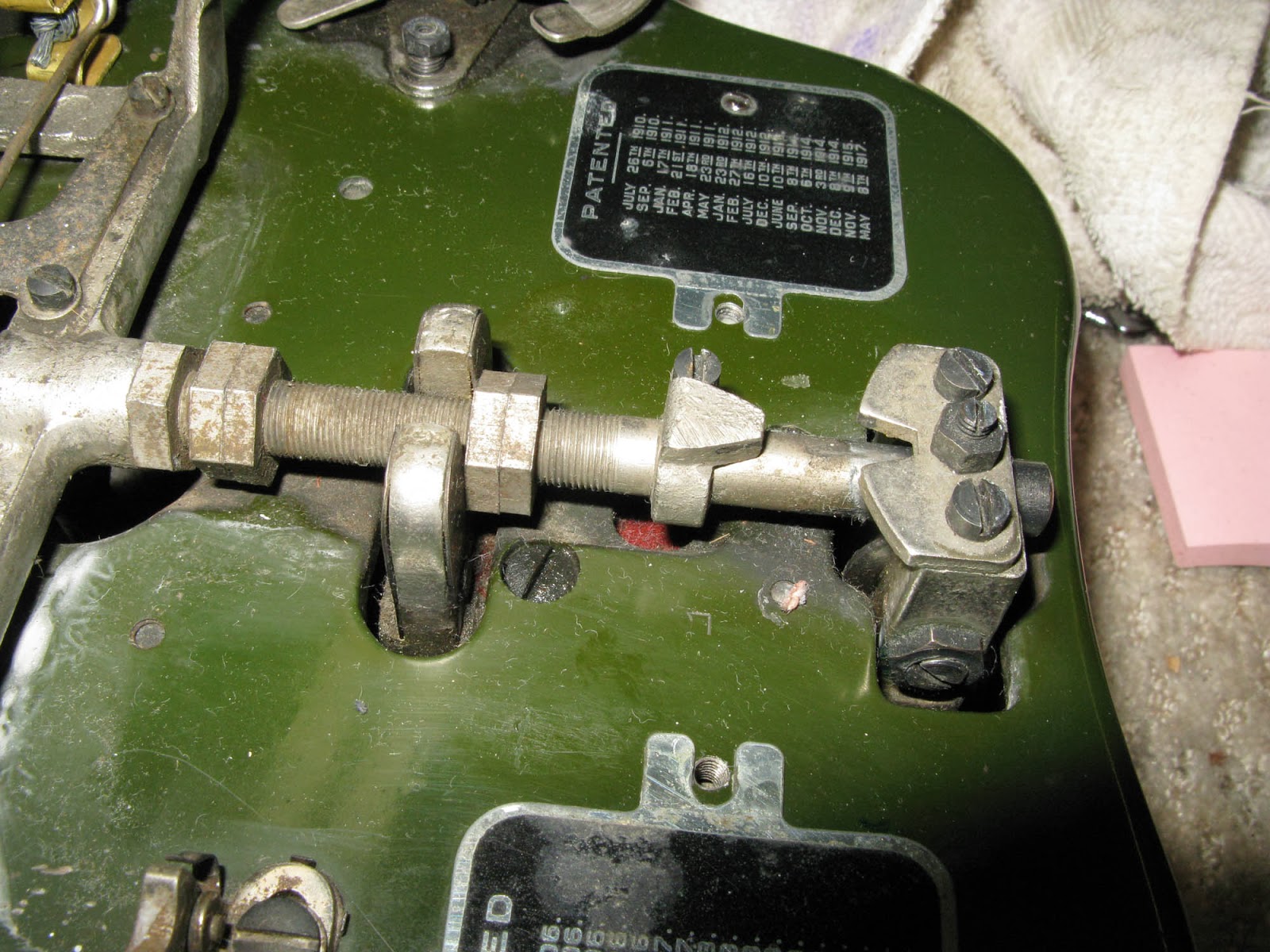
OK - here's where we get into the ingenious mechanism that allows the carriage to be removed without an issue with the drawstring. Remember that "staple" I set aside and lost? That is the hook on the end of the draw cord. It is captured and held by that fork as the carriage is removed. A part "sine qua non". 

.

Not finding the draw cord hook i fashioned one from some brass stock.

.
Here's my draw cord hook in its place on the end of the carriage.

.
And here it is, captured by that fork as the carriage was removed by sliding it to the right in this view. I use picture-hanging cable as a draw cord. See that pigtail the cable passes through? A kind thought by the designers that would capture the cord keeping it from flying around should things go wrong and the hook get unseated from that fork while the carriage is off. When the carriage is replaced, the tab on the top of the hook slides into its place on the end of the carriage and you are good to go. Ingenious!

.
The odd bump on the rear of the machine houses the stops for the CAP and FIG positions.

.
Here it is in neutral, i.e., lowercase, position.
.
CAPs position
.
FIG position. Amazingly solid. As is the rest of the machine. But the basic design limited typing speed, and was doomed.
.


Wednesday, October 9, 2013

Psychological Care

This post is provided to explain a possible gap in future posts by Tony Mindling, the author of this blog. It includes a copy of a letter from a clinical psychologist that may have been (or may not have been) sent to Mr. Mindling's son, Eric. Note that clicking on the images will provide a larger, more readable version.


Saturday, October 5, 2013

Which Three?

You have visitors. One remarks on a typewriter you have on your desk. Perhaps they are genuinely interested, because it resonates with some memory of theirs, or maybe they are already aware of Your Problem and are curious what makes you tick. Based on their few words and with a speed and set of algorithms that would put to shame the fastest computer, you size them up and make your decision.  The decision is not trivial; you've painfully experienced the blank stares and stifled yawns of non-believers. But this time you sense some genuine light there, and decide to usher them further into your sanctum and reveal a few of your precious pretties. Say, three of them.

Which three?

Think it over. You have machines that are important for their font, or they represent a transition or period of design. Perhaps some that simply do their job very, very well. But let's say your visitor is younger than 50. That means that their experience with actually having used typewriters would have been very fleeting, if they'd had any at all. What would engage their interest?

OK, I'll go first.


1. My old Royal 10. The thing is majestic in its black glossiness and beveled glass, and the epitome of typewriter vintageness. Plus it works well, and folks have fun typing on it and hearing its clear bell sound.

2.  Olivetti Valentine. Folks are often surprised at the bright colors used on typewriters, and the Valentine has that covered, along with Ferrari styling. And the integrated case thing is intriguing.

3.  My just arrived Oliver No. 9. Those typebars flying through the air like a deranged cheese slicer just have to be impressive. Plus it has the whole funky steampunk thing going on.

So I've shown you mine - now it's your turn.

Friday, October 4, 2013

Meet Rusty and Ollie

Rusty is a 1949 Smith-Corona Sterling; corroded, marginal margin settings, wonky line advance, White-Out be-spattered, hesitant keys, and a bit musty smelling. I nearly passed on it yesterday until noticing its wonderful font. While in the midst of typecasting with it today a Fed-X truck arrived with Ollie, a mighty fine looking Oliver No. 9. But here, let's have Rusty tell the tale:


Rusty ... he just makes me happy. Grimy, corroded, but with real soul.


Meet Ollie. His pencil holder swung the deal. Stay tuned.

Friday, September 20, 2013

Blue and Green

The first coat of spar varnish and marine paint applied,
the workshop is suffused with an intoxicating ambiance
Even the delicious odor of spar varnish and boat paint could not fully distract me from typewriters, could not alleviate the insatiable need, the sense of acquisition opportunities being missed. Was it something Manson Whitlock once said, that portables, their performance compromised by the need to fit too much into too small a space, could never match the big standards? Once my attention wandered from boat maintenance toward typewriters, it veered toward those regal and stately machines. Staggered by the workshop fumes, I found myself checking the eBay listings between varnish coats for the big guys. Those pre-1930 beasts, their massive cast iron architecture decorated by ornate lettering and gold scrollwork. And there it was - a beauty - in what looked to be in good condition, and free shipping at that! Alas - although newly listed, some undeserving wretch had already snapped it up. Frustrated now, and a bit pissed off, I began to slam through the listings, determined to find a machine as fine and a deal as good. Aha - there it was.

1929 Underwood No. 3

A gleaming 1929 Underwood No. 3, in all its glossy black glory. For local pickup only, but, wonder of wonders, only a couple of miles away. This one would not escape. It could have been a junker, a hopeless wreck, and I would have carried it home chortling and chuckling, in my deranged rebound from the supposed beauty that had been stolen from me. But on the workbench it seemed to be a solid machine, even deserving of the blue ribbon I'd been saving for something special. Clacking out the old standard phrases, bouncing the type slugs off the granite-hard platten, all the keys did their thing, as did the backspace, margin release, ribbon reverse and advance, line spacing. Amazing. and 84 years old, too. Finally mollified, I filled a page with blue words (not that kind of blue), chuckling all the time hunched over in my dim bunker.

While in ribbon installation mode, I plopped a green one into Kermit, a lovely little Royal Royalite recently acquired from Mike Clemens, who is inexplicably experiencing a need to de-acquisition that no doubt he will regret, but that I've been doing what I can to help with.

Kermit, the Royal Royalite

I promise an addendum to this post with typing samples, in the appropriate blue and green, from each of these machines.

But first I  need to apply another coat of varnish and marine paint.
================================================
ADDENDUM I
1921 Underwood Typing Sample

ADDENDUM II
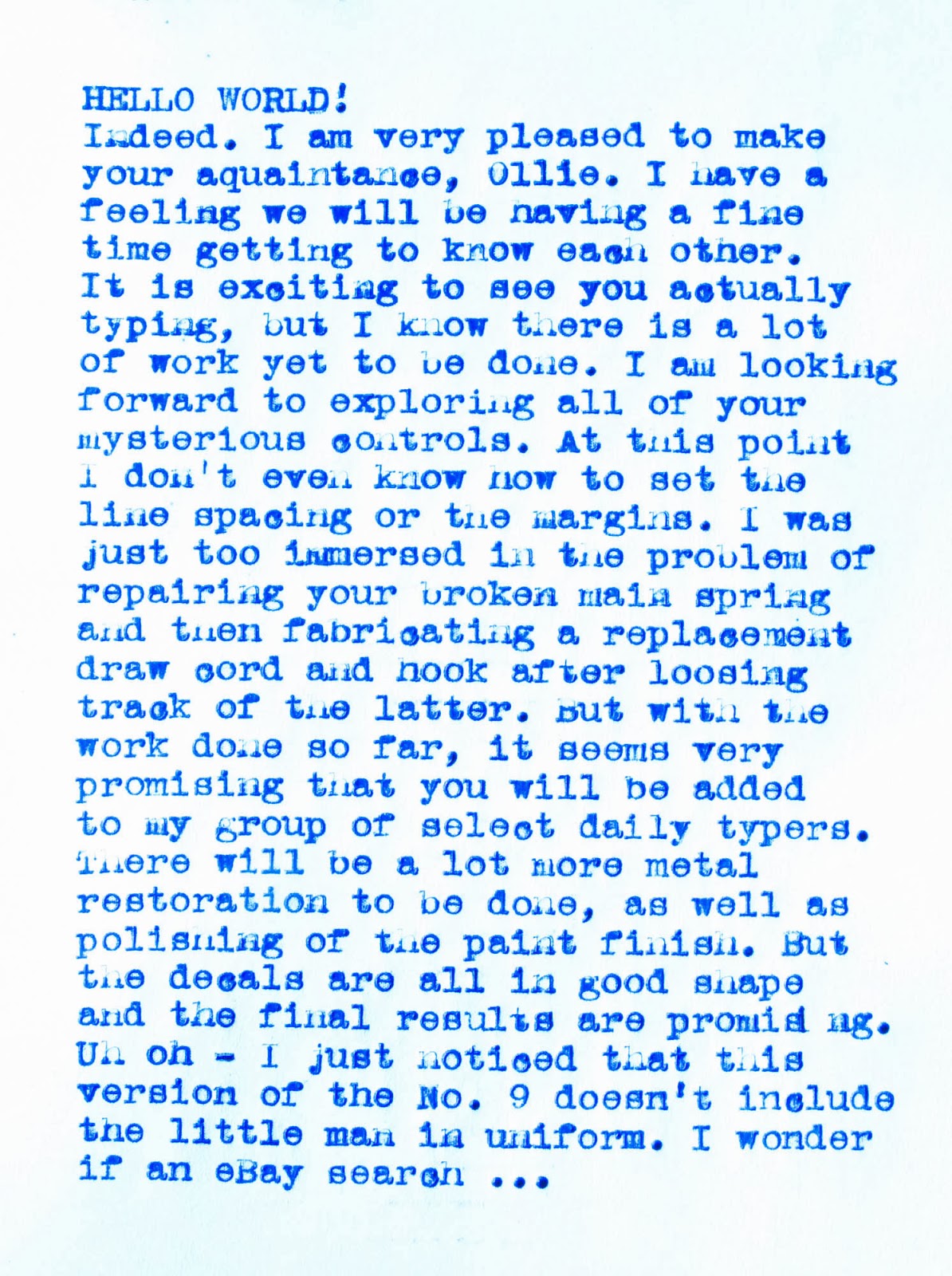
1957 Royalite Typing Sample