Thursday, September 19, 2013

Sharlet - a Love Affair

Like all love affairs, there have been cycles ranging from "smokin'", to "taken for granted"; periods where you can't get enough, to periods where you forget the need to maintain and nourish. And so it has been with Sharlet. Sharlet is a sailboat. A 15-foot, sloop rigged daggerboard Windmill Class racing sailboat who has been part of our family for many decades. She is equally adept at providing a pleasant day sail for a couple of adults, or the skipper and two or three children in gentle breezes, as she is at providing a thrilling ride skipping across the wave tops on a reach while you hang on wide-eyed at the ragged edge of control.
Hilda and I preparing for a camping trip to Eagle Lake in 1977. Sharlet is tagging along behind the "Camper", which will also soon be burdened with our 17-foot Coleman canoe - and several of our seven children.

For over a decade it was all about racing, at least one weekend a month during the season. Over those years we gradually learned how to skipper and crew in the relentless, wave-curling blasts of the Nevada desert wind that Mark Twain called the "Washoe Zepher". By the time we had things figured out, in the late 1970's, and managed to snag the Windmill District Championship cup for two years in a row, the popularity  of sailing, especially monohulls, was in decline.

Hilda preparing for a race during a regatta at Eagle Lake, 1979


The gang at Eagle Lake in 1980. All of our combined family of seven kids enjoyed time with Sharlet. She served us faithfully on outings like this for the following three decades, asking little in the way of maintenance.
And then in 2007 sailing activity perked up, thanks to expert Windmill sailors Scott Rovanperra and Dave Nielsen. They coaxed me and Sharlet out of retirement and back to the starting line.

Racing with grandson Jeremy at Scott's Flat. Borrowed newer sails convinced me it was time to provide Sharlet with a new wardrobe.

It took only a few races to reveal that both the sails and the skipper were a bit blown out. Not only that, but those pounding planing reaches across Eagle Lake had opened up cracks in the hull. 

Summer 2007 - beginning serious restoration

2007 -The double hull has been been repaired with nautical foam, re-fiberglassed, and then finished on the inside with skid-proof paint.

2007 -Gouges resulting from many years of pulling Sharlet up on beaches, and more importantly, cracks through the outer hull that resulted from all of those pounding broad reaches across Eagle Lake, have been repaired, filled, and faired.

2007 - Sharlet turns from dirty gold to bright blue.

2007 - First coat nearly done. And not a bad job, either. 

2007 - The skipper celebrated completion of the paint job with a dip in the American River

Summer 2010 - Sharlet is back at Eagle Lake, with a solid hull, new paint, and new North sails, ready for a few more decades of sailing.

2010 - launching at Eagle with grandson Jeremy.

Eagle Lake, 2010. Daggerboard and rudder are still functional, but have yet to be fully refurbished.

Dave and Sarah at Lake Washington, West Sacramento, 2010

Scott and Montana, Lake Washington, West Sacramento, 2010
Now, during the last few days of summer, 2013, I'm inspired with another burst of enthusiastic maintenance energy, this time aimed at the rudder, tiller, and daggerboard. Was it inspired by Darrel, who continues to carry the Windmill flag, building new boats, restoring old warriors, and engaging new sailors? Or realizing that the thought of replacing Sharlet with a slower, more comfortable craft were akin to selling a family member? Or the excitement of watching the non-boats of the America's Cup duke it out? No matter. I'll cling on to the tail of this horse named Enthusiasm and hopefully hang on until these pieces of wood are as solidly gleaming as Sharlet's hull.

Fairing and sanding the rudder cheeks

Rudder and daggerboard, nearly ready to varnish


Last check before beginning to varnish. I think the tiller favors the starboard tack ...

Sunday, September 15, 2013

Facing the Typewriter Problem

Don't think it can't happen to you. It'll begin in the company of a few friends. You've already had a couple, what would one more hurt. But you keep wanting more, and eventually realize as you stumble around the clutter that the habit is taking over your household and affecting your life. Your wife tearfully confronts you when she finds you have even squirreled some away in her side of the closet. You thought it could never happen to you, that you were in complete control and could stop any time. But one day you find yourself facing your friends with the statement:

Hello, my name is Tony Mindling and I'm a typoholic.

===========================================

For clinical evaluation, the following documentation collected during the past few weeks is herewith provided. Not included are the Smith Corona Quiet Super from the local Salvation Army thrift store, and the Royalite, AKA "Kermit", from Mike Clemens. Of course, many of these are destined for grandchildren, some of whom have already expressed interest. Of course, one little problem with that justification for my typewriter problem is that I don't see our seven children, prolific as they are, producing 43 children. So I suppose I will just have to give in, and, as one notable Typeospherian suggests, embrace hoarding. One positive thing is that all of the typewriters below, at least all that have thus far been received, have functioned well right out of the box. Well, OK, the Harris needs a new drawstring. Oh, and that pretty blue Corona Coronet arrived in pieces that all the kings men ... but the seller provided a complete refund and parts have already been shared all the way to Australia. They did arrive, didn't they McTaggart?


Friday, September 13, 2013

Good Things Come in Threes

Tony at the races with Claire and monica
They came all the way from Georgia to enjoy a week of the America's Cup finals, so the least I could do was to play hooky and join them for a day.

Three San Francisco icons: The Ferry Building on the Embarcadero, close to the America's Cup festivities; Coit Tower on Telegraph Hill; and towering over the Bay on the Marin County side, Mt. Tamalpais
.
Claire
I'd previously known Monica Mindling Heidesch, her husband Troy, and daughter Claire only through Facebook posts. I think grandfather George Mindling posts as many photos of Angelic Claire as her parents do, and no wonder. A spirit child in a way, 6-year-old Claire was born way early and weighed in measuring in ounces. She and her mother would likely not have made it in earlier times. It was a great treat to be able to spend some time with her.


Three fine folks at the races: Troy heidesch, daughter Claire, and Monica Mindling Heidesch ...

As far as the races went, we could not see much of it from our vantage point other than via the many huge screens. But the most telling scene played out in the morning right in front of me as the crew exited the stage after the introductions, marching right past me. The smiling and waving Kiwis were in telling contrast to the grim and determined visages of the USA Oracle team. And no wonder - entering the day already down by several races, Team USA would loose another two by days end. More photos from my day at the races here.

The grim and determined visage of Team USA was in contrast to ...

... the confidently smiling Kiwi team


Three New Typewriters ...

Kermit, the green Royalite
On the drive back from the Bay toward our rollin', golden hills, I stopped off to pick up a cute little Royalite from Mike Clemens. While reading his blog, Click Thing, a few days ago, I discovered that he still had a few machines looking for caring homes. What was I to do, but help him out by adding Kermit to my collection. I have a green ribbon that should suit him perfectly.

Kermit is a cute little travel typewriter in excellent shape. He even comes with a zipper travel case, that has also been well cared for. A great find by Mike, and I am grateful to him for making it available to me. Chances are it will go to one of my 13 or so grandchildren, several of whom have been clamoring for typewriters since I began my letter-writing program to them. Unless, that is, I decide to keep Kermit for my own use on our RV trips.

And then another stop. This one in downtown Sacramento, where it turned out that forging through the rush hour traffic was well worth it, as I picked up a lovely Remington Deluxe Model 5 from an eBay seller.


And then at home, awaiting me in a huge carton; A 1911 Harrris Visible. The first standard machine I've collected since pulling my cherished Royal no. 10 from a neighbor's trash can back in 1967. Who needs more than one standard? But I couldn't resist the opportunity to acquire a lovely vintage relic, a 3-bank double shifter at that, that seemed to possibly be in usable shape.

Already in very good cosmetic shape, some spit and polish should get this Harrris Visible gleaming. In case anyone
new to typewriter history has made it this far, the name of this machine points out its advantage compared to earlier
upstrike machines, where the type slugs impacted the platten from beneath, thus making the current line invisible
until the platten was rotated.


Lots of levers and keys whose mysterious functions have yet to be revealed to me


The spring that pulls the carriage draw string can be tensioned and adjusted by means of the winder on the left and the
lever on the right. The winder tightens the spring, like winding a mechanical alarm clock, and the lever releases the tension
one click at a time. this will make replacing the carriage draw band a snap - one of the few apparent issues of this
lovely old typer.


Monday, September 9, 2013

Typewriter Spotting

As my wife and I work our way through our addiction to Mad Men I'm wondering if others in the typosphere have recognized what a fine venue the series, set in the 1960's, is for typewriter spotting. A description I've heard of the series as "relentlessly nostalgic" is right on. The office of the 1960's Madison Avenue advertising agency is of course filled with IBM Selectric I's, the "golf ball" typewriter. Quick shadowy glimpses of other machines create an identification challenge. But Don Draper's personal typewriter, identical to my beloved high school machine, was easy.

Poor Don Draper. Occasionally deeply empathetic in his relationships with women, he can also be crudely clueless. Here he is trying to compose a note of apology to his secretary, whom he has managed to cause to leave the office in tears.
The solid and smoothly functioning late 1950's Olympia SM3 is no help. His secretary has developed an adoration for him;
they both realize it is best she seek another position. But when she asks him to write her a letter of recommendation,
hoping he might cast a few crumbs of recognition and appreciation her way, he tells her to write one up herself, saying
whatever she likes and he'll sign it. He has no idea why she responds by hurling a desk ornament at him.
He's barely begun the second sentence of his letter of apology, and already he's talking about himself. He's clueless,
but the SM3 is a great typewriter.

Sunday, September 8, 2013

On the Pleasure of the Flow of an Afternoon in Good Company


Art on the Divide Gallery, Georgetown, California
Our Sunday morning didn't start out that way. With a pleasurable flow, that is. Although Hilda and I had both been absorbed for the last week and more in preparing for the opening party for my little art show, we were reluctant to begin the day. Hilda had been planning and preparing hors d'oeuvres, and I'd kept on adding to and embellishing the presentation up to the last minute. We were pooped. So instead of leaping out of bed on D day, we both slept in. Not with that pleasurable lassitude deriving from the prospect of a lazy Sunday, but out of reluctance to initiate a day that would take more energy than we felt we had to get it rolling.

But rolling was eventually accomplished, in that gradual but noisy fashion of a steam engine pulling out from a station, with the sound and fury of billows of steam, loud exhortations of puffing and chuffing, and eventually rolling merrily along fueled by its own momentum.

Hilda puts final touches on her creations while a
soft summer breeze wafts through the old building ...
A momentum aided mightily, once we finally managed to present ourselves at the gallery, by the other coop members. They pitched in by helping to carry and set up and fill in gaps. There appeared a bouquet cut from the gallery's own historic rose garden, the corkscrew we forgot, music, balloons, wine from home-grown grapes, and more snacks. And soon the day that we had been so reluctant to begin was merrily rolling along, impelled by the pleasure of good conversation in the company of friends, conversation the flowed the afternoon too quickly away.

... and the guests begin to blow in.

Saturday, September 7, 2013

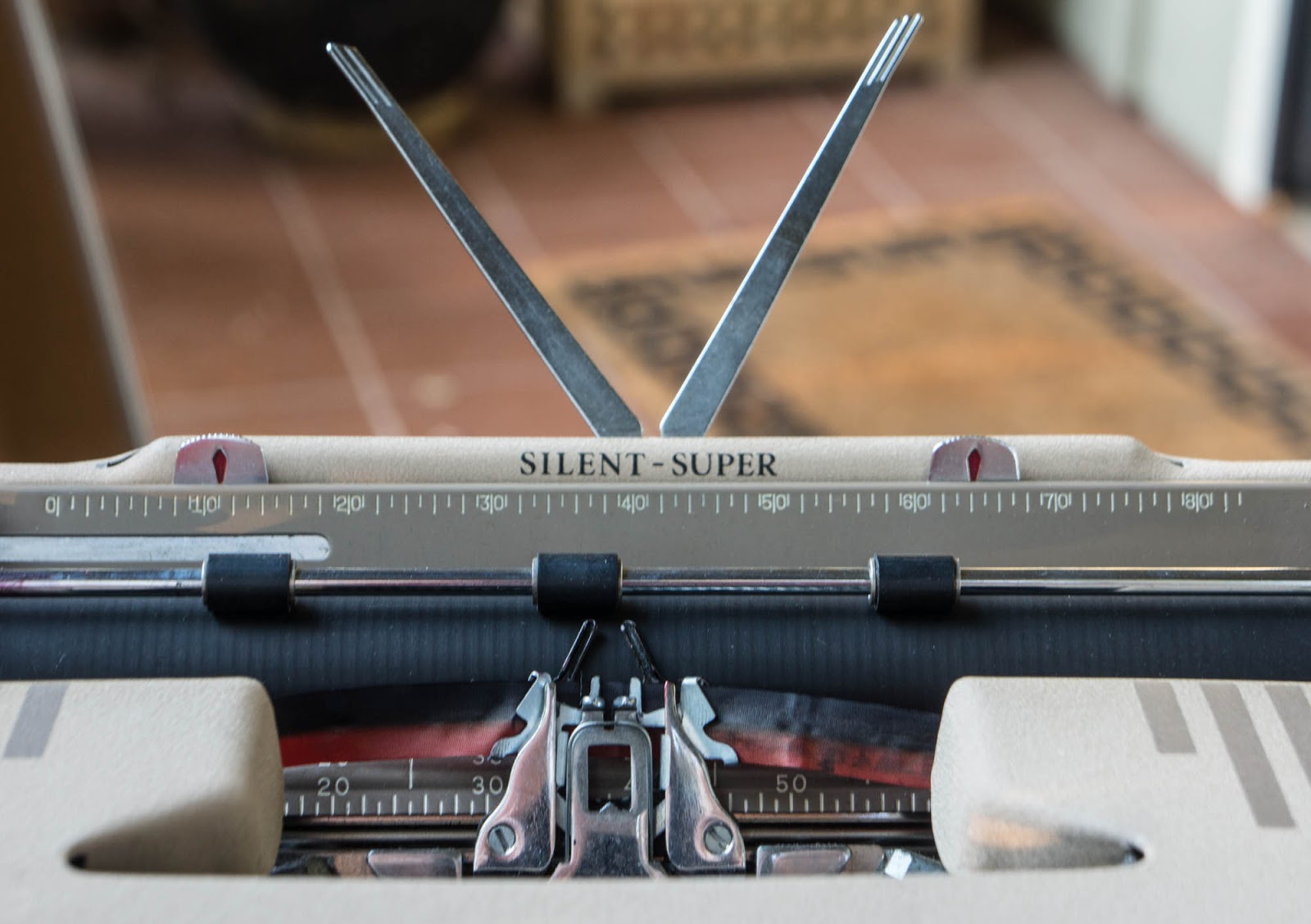
Smith Corona Silent-Super

Super, indeed. Found this week at the local Salvation Army Thrift Shop, this typer is among the smoothest-functioning and quirk-free machines in my growing collection, and all I've done is replace the ribbon.
Smith Corona Silent-Super, circa 1958-59
The color is attractive, as is the fine sandy texture. And it retains the vestigial art deco Smith Corona stripes.


It has a nifty system to anchor it within the case:

The lever on the left withdraws a tab from the front of the typewriter, which can then be removed from the case.


Set the typewriter back in the case and it snaps into place.

This model was re-branded and sold by Sears as the Tower Quiet Tabulator:

The Tower Quiet Tabulator as shown on Richard P's "Writing Ball" blog 
Alan Seaver's blog, Machines of Loving Grace, includes an interesting article on catalog store re-brand of typewriters 

Wednesday, September 4, 2013

Exa Excitement

Some time ago I posted about the excitement of receiving my first "real" camera, an Exakta VXIIa, that came all the way from Switzerland. That was back in 1958 when I was a high school senior. That wasn't quite so long ago as when imaging was the province of shamans with ground pigments in the secret recesses of caves, but it might as well be, given the vast differences in viewfinder imaging technology then and now. For those photographers who take for granted the LCD monitors of smart phones and the electronic viewfinders of today's mirrorless cameras, you need to know that once upon a time there were these tiny peep holes on the back of what were known as rangefinder cameras that revealed only an approximation of the crop that would be captured on film, let alone depth of field. And changing lenses involved attaching cumbersome auxiliary viewfinders that still only approximated the changed angle of view. The development of the single lens reflex (SLR) camera, that provided a through-the-lens view via a prism and mirror system was a giant step. Photographers soon separated into two camps: the rangefinder folks with their Contaxes and Leicas who extolled handiness and quickness, and the SLR folks that accepted the cumbersome size and weight and louder shutter in exchange for the enhanced visualization.


Aura Estes with San Rafael High School camera clubers
on a Marin County Beach, circa 1957
My first view through a single lens reflex was an exciting revelation. It came about through one of those educators; those underpaid, under-extoled folks, who so often change our lives. In  my case that was our chemistry teacher at San Rafael High School, Mr. Aura Estes. He'd established a darkroom attached to the chemistry lab, sponsored our camera club, and somehow acquired and made available a few cameras that we used to document school functions for the school newspaper and yearbook. As club members we could also check out equipment to use outside of school, and so it was that I got my dibs on the Exa as often as I could. It was made in Dresden Western Germany, and like its big brother the Exakta used a prism and mirror system to provide that single lens reflex view. I was enthralled with that shimmering image that gave such a good sense of the image projected onto the film, and enhanced my sense of exciting photographic possibilities. By the time I was a senior I'd I saved up my summer job dollars and mailed off for an Exakta and soon forgot the Exa.

But a couple of weeks ago during my all-too frequent rambles through eBay there was an Exa at a decent price and not even bad shipping cost, considering it would make its way all the way from Bulgaria. I once again got the urge to hold in my hands an example of a tool that had once inspired me, and also liked that it would be coming via post from Europe like the Exakta did.

An Exa SLR with big brother Exakta in the background
 I was not disappointed. Like the Exakta purchase, that came from South Africa a couple of years ago, it arrived in perfect operating condition. (I will not dwell on whether my Sony Nex 7 will still function, and if batteries or memory cards will be available for it  in 55 years.) I will soon run a role of film through the Exa, enjoying that old feeling of visualization, the feel of the machined controls, and the ker-slap of the shutter. But it is pleasure enough to just hold it, feel its heft, and recall those days when photography was new and exciting. And it still is.